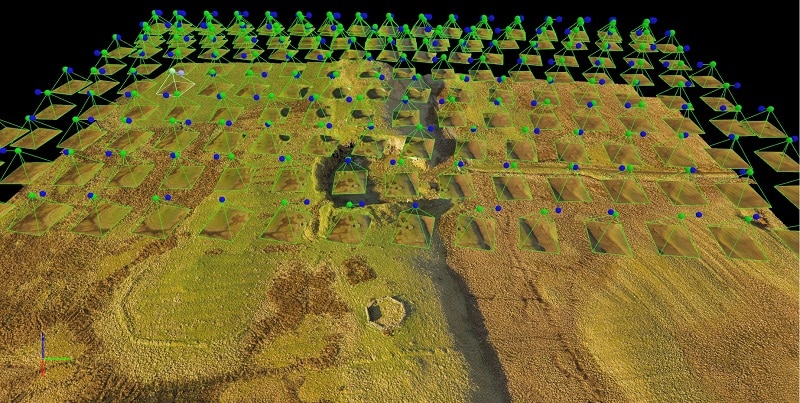



Drones are rapidly transforming geospatial and surveying practices, offering unprecedented efficiency and accuracy. While historical limitations hindered their widespread adoption, recent technological advancements have solidified their position as indispensable tools in the mapping and survey industry.
Increased Efficiency
Reduce fieldwork time and processing effort, accelerating timelines and improving client satisfaction.
Improved Safety
Replace ground surveying in hazardous areas, minimizing personnel risks and liability exposure.
Enhanced Data
Capture high-resolution data with greater density for more detailed, accurate area representation.
Solutions to power every phase of your project
Transforming geospatial practices with advanced drone technology and precision surveying solutions
Drones equipped with RTK/PPK systems achieve centimeter-level accuracy, producing detailed topographic maps for construction, infrastructure planning, and environmental monitoring projects.
Volumetrics
Quickly and accurately calculate precise volumes of stockpiles, excavations, and other earthworks, streamlining material management and cost estimation for survey clients.
3D Modeling
Capture high-resolution imagery and LiDAR data to generate detailed 3D models of terrain and infrastructure, creating digital twins for analysis and visualization.
Corridors
Map linear infrastructure corridors including roads, railways, and pipelines efficiently. Beyond Visual Line of Sight (BVLOS) waivers enable extended corridor mapping applications.
Environmental
Monitor erosion patterns, track vegetation changes, and assess environmental impacts, supporting environmental management and conservation planning efforts.
Disaster Response
Rapidly assess damage after natural disasters, providing critical surveying information for emergency response teams and recovery operations.
Topography
Drones equipped with RTK/PPK systems achieve centimeter-level accuracy, producing detailed topographic maps for construction, infrastructure planning, and environmental monitoring projects.
Volumetrics
Quickly and accurately calculate precise volumes of stockpiles, excavations, and other earthworks, streamlining material management and cost estimation for survey clients.
3D Modeling
Capture high-resolution imagery and LiDAR data to generate detailed 3D models of terrain and infrastructure, creating digital twins for analysis and visualization.
Corridors
Map linear infrastructure corridors including roads, railways, and pipelines efficiently. Beyond Visual Line of Sight (BVLOS) waivers enable extended corridor mapping applications.
Environmental
Monitor erosion patterns, track vegetation changes, and assess environmental impacts, supporting environmental management and conservation planning efforts.
Disaster Response
Rapidly assess damage after natural disasters, providing critical surveying information for emergency response teams and recovery operations.